

Solid Mixing
Keywords:Solid mixing, briquette machines, vertical intensive mixers, horizontal intensive mixers, mixers
Source: internal company
Solid mixing is an essential unit operation in industrial sectors including chemical engineering, metallurgy, building materials, pharmaceuticals, food and feed. It also serves as a pre-process core procedure in the production flow of briquette machines. Consistent and desirable mixing performance directly determines the uniformity, strength and qualified rate of finished briquettes. The selection and operation of intensive mixers (including vertical intensive mixers and horizontal intensive mixers) are critical to guarantee mixing quality and connect subsequent briquetting processes, and also lay the foundation for the design of complete powder processing and briquetting production lines.
1. Solid Particles
In practical application of mixers matched with briquette machines, solid materials mainly refer to powder and granular materials, which are generally divided into granules and powders. In the industry, particles with a particle size of approximately 50μm are taken as the dividing line. The maximum particle size of granules can reach several millimeters, which perfectly meets the material requirements of briquetting processes.
The essential difference between the two lies in the mechanical behaviors of particles, which directly affects the mixing effect of intensive mixers and the forming quality of briquette machines:
The movement of granules is mainly controlled by gravity. They feature good flowability, suitable for mixing in both vertical and horizontal intensive mixers, and rarely agglomerate.
As particle size decreases, inter-particle adhesion, van der Waals force and electrostatic force gradually increase, raising the difficulty of mixing.
When the particle size drops to tens of micrometers, adhesion force and gravity tend to balance. For uniform mixing, forced stirring by mixers (especially horizontal intensive mixers) is required.
When the particle size is further reduced to several micrometers, gravity becomes negligible. Particles tend to agglomerate into aggregates and cause the phenomenon of "reverse pulverization". The shearing and dispersing functions of intensive mixers are needed to break up agglomerates so as not to impair briquette forming.
Practice proves that excessively fine particles (below 3μm) do not necessarily improve the overall mechanical properties of mixtures. In the process matching of intensive mixers and briquette machines, a reasonable particle size combination plays a vital role in the strength and stability of finished briquettes.
2. Introduction to Solid Mixing (Indispensable Pre-process for Briquetting)
Solid mixing is a unit operation where two or more types of powder and granular raw materials for briquetting are evenly dispersed under dry conditions or with a small amount of liquid (binder) added, driven by external force from intensive mixers. It is an indispensable pre-procedure before briquetting.
This is a random process where the inhomogeneity of materials keeps decreasing. The theoretically ideal complete mixing is hardly achievable. The optimal uniform state realized in industrial production, especially in briquetting processes, is defined as random complete mixing. It acts as an important reference for the design and model selection of mixers and matching mixer units for briquette machines. Superior mixing performance effectively prevents delamination, cracking and insufficient strength of finished briquettes.
3. Main Influencing Factors of Solid Mixing
Different from liquid mixing which relies on spontaneous diffusion, solid materials have almost no self-diffusion capacity. Uniform blending can only be realized through forced flow driven by mixers. The mixing effect greatly influences the production efficiency and finished product quality of briquette machines.
Key factors affecting mixing performance are summarized as follows:
(1) Material Properties (Core Factor)
Particle size and particle size distribution, particle shape, bulk density, surface characteristics, static electricity, moisture content, angle of repose, flowability and agglomeration tendency all affect the mixing uniformity and efficiency of vertical and horizontal intensive mixers, and further impact the forming effect of briquette machines. For instance, materials with excessive moisture content need pre-stirring in intensive mixers to avoid mold adhesion and caking during briquetting.
(2) Structure and Type of Mixing Equipment (Key Factor)
Mixers with different structures vary greatly in mixing mechanism, working intensity and applicable materials. Model selection shall be conducted in accordance with the requirements of briquetting processes:
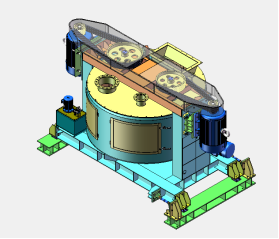
Vertical intensive Mixer: Compact structure and small floor occupation. Ideal for small and medium-sized briquetting production lines with high mixing efficiency, applicable to powder and granular materials with good flowability.
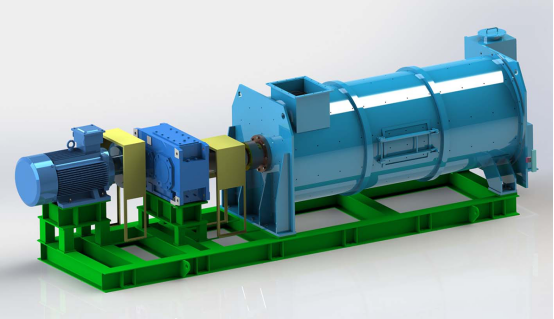
Horizontal intensive Mixer: Long stirring stroke and high mixing uniformity. Capable of handling viscous and agglomerating materials. It is widely used in large-scale briquetting production lines and can effectively break up material agglomerates to ensure briquette quality.
Auxiliary Mixing Equipment: Matched with vertical or horizontal intensive mixers according to raw material characteristics and production capacity to form a complete pre-briquetting mixing system.
(3) Process Operating Parameters
Filling ratio, mixing time, rotating speed, feeding sequence and liquid wetting all affect the final mixing quality, and exert a remarkable impact on briquette forming and product qualification rate. Insufficient mixing time will lead to uneven materials, resulting in inconsistent strength and easy breakage of finished briquettes.
4. Three Basic Mechanisms of Solid Mixing
The movement of powder and granular materials inside mixers is governed by three basic mixing mechanisms, which coexist and interact throughout the mixing process. Each mixer type is dominated by one specific mechanism to meet different briquetting process requirements.
(1) Diffusive Mixing
It refers to the random movement of particles in a small range to achieve local uniformity by enhancing the migration of individual particles. Diffusive mixing delivers high uniformity and usually occurs when new free surfaces are continuously formed. It is the dominant mechanism in vertical mixers and suitable for mixing free-flowing powder and granular materials for briquetting.
(2) Convective Mixing
Particles move in groups on a large scale and circulate inside the mixer to complete blending. Convective mixing features fast speed and high efficiency. As the leading mechanism of horizontal intensive mixers, it realizes rapid uniform mixing of large batches of briquetting raw materials and improves the overall efficiency of production lines.
(3) Shear Mixing
Mixing is completed via relative sliding, shearing and friction between internal particles. Shear mixing plays a prominent role in blending high-viscosity, agglomerative, fibrous materials or materials wetted with liquid binders, and can fully break up agglomerated particles. This mechanism is highly evident in horizontal mixers. It stabilizes the state of raw materials before briquetting and guarantees the quality of finished briquettes from the source.

Where there is briquette, mixing, drying,
and related system solution,there is Kaizheng
Copyright@2024 Luoyang Kaizheng Environmental Protection Processing Equipment Co., Ltd