System solution -Cold Briquetting Process
System Introduction
There are mainly two situations:
1. Handling materials containing high calcium (such as calcium oxide)
2. Various other materials
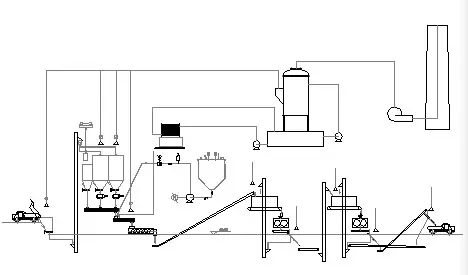
1. High-calcium metallurgical dust cold Briquetting process
The process flow is shown in Scheme 1 of Attachment 3.
The dust from converter furnaces and electric furnaces usually contain a large amount of calcium oxide and iron elements. Through the cold Briquetting process, these products can be used as cold slag agents, and this kind of resource utilization process has been widely applied in China.
There are several difficulties in handling this type of material:
◆ Because it contains water-absorbing materials such as calcium oxide, the hydration process is necessary.
◆ Usually, the raw materials have a certain temperature, and some can even reach as high as 400 degrees Celsius.
◆The material is very fine in size, has a very low bulk density, and is difficult to compress as well as causing secondary pollution issues.
The main process steps:
◆ Raw materials dosing
◆ Hydration treatment(Including: mixing, pre-compression, etc.)
◆ briquetting
◆ Wet dust removal, etc.
2. Various other materials cold Briquetting process
2.1 Application field / Materials:
◆ Wet dust removal sludge from the converter furnace
◆ Sintered ore with small particles
◆ The small particles of oxidized pellet
◆ Red soil nickel ore raw material
◆ Fluorite powder
◆ Manganese ore powder, chromium ore powder
◆ Small particles of manganese iron, chromium iron and nickel iron
◆ Electrolytic manganese metal
◆ High-aluminum coal gangue, magnesite, calcined magnesium oxide, magnesium hydroxide, magnesium oxide, calcium oxide, Aluminum oxide etc.
◆ Aluminum slag, gypsum-based materials, etc.
◆ Phosphate powder, a mixture of phosphate powder and coal(The raw material of yellow phosphorus)
◆ Lignite, bituminous coal, coke powder, etc.
◆ Rock salt
◆ Lithium ore powder
.......
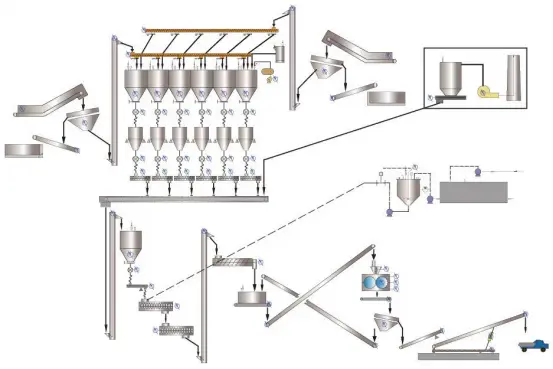
2.2The main process steps:
◆ Raw materials drying(Not all materials require this step.
◆ Raw materials dosing
◆ mixing and briquetting
◆ Briquette drying(Not all materials require this step.)
◆ dust removal, etc.
Based on the Finished product
1ton/hour to 40tons/hour
Our company has testing equipment that can conduct material tests and determine the process.
◆ Raw materials drying(Not all materials require this step.
◆ Raw materials dosing
◆ mixing and briquetting
◆ Briquette drying(Not all materials require this step.)
◆ dust removal, etc.
Capacity of a single production line
Based on the Finished product
1ton/hour to 40tons/hour
Our company has testing equipment that can conduct material tests and determine the process.
Project implementation process

Where there is briquette, mixing, drying,
and related system solution,there is Kaizheng
Copyright@2024 Luoyang Kaizheng Environmental Protection Processing Equipment Co., Ltd